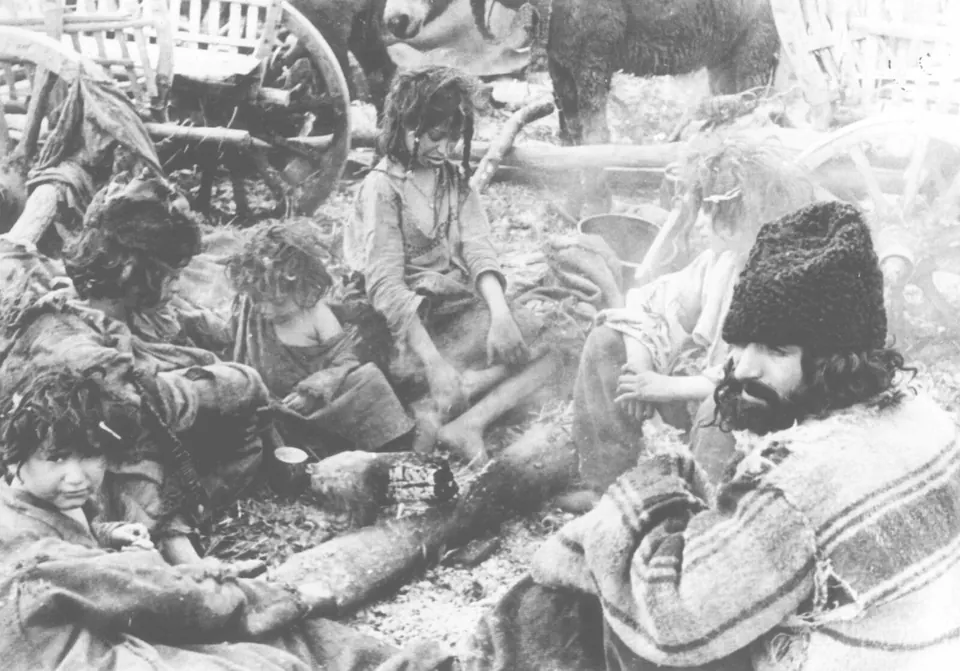
The road of history, in brief
The history of the Roma in Romania has mostly been written by others about them. Below we have tried to tell it simply, in five stages, without hiding anything that was hard.
-
14th–19th centuries
Slavery
The Roma are documented in Wallachia as early as 1385. For almost five centuries they lived as slaves of the princes, the monasteries and the boyars. A Roma child was born a slave and died a slave. They could be sold, given away or separated from their family simply because of their origin and the colour of their skin. Even Roma without an owner were officially slaves of the state.
Slavery was abolished only in 1855 in Moldavia and in 1856 in Wallachia, when the elites of the time chose to align with the European ideals of the Enlightenment.
-
1856–1940
Freedom without opportunity
Emancipation brought freedom on paper, but no land, no housing and no access to education. The attitude of the majority changed very slowly. The Roma continued to be seen as people of a lower rank, and marginalisation was passed down, in practice, from one generation to the next.
-
1942–1944
The Holocaust
During the Second World War, the regime of the time deported around 25,000 Roma to Transnistria, including entire families with children and elderly people. According to the report of the International Commission on the Holocaust in Romania, nearly half of them died of hunger, cold and disease. For a long time, this chapter was passed over in silence in school textbooks.
-
1948–1989
Forced assimilation
The communist regime had no social inclusion policies for the Roma. Instead, it tried to change their way of life radically: it forced them to settle down and to give up their traditional trades for industrial jobs. Because of poverty, many children ended up in children’s homes and orphanages. This policy of quasi-assimilation failed.
-
After 1989
A hard transition
Democracy arrived, but discrimination stayed. Many Roma had no education and no qualifications, in a poor country that was governed for years without a real development strategy. Other former communist countries, such as Poland, managed a far more successful transition. After the 1990s, the chances of a decent life in Romania for unskilled people became very slim, so many Roma, and many poor Romanians too, left to work abroad and support their families.
There are also Roma who managed to integrate and succeed. Most of the time, their success is the result of the wisdom and enormous efforts of their own families, not of public programmes.
What history tells us
The Roma lived in slavery for almost five hundred years, and for the last hundred and fifty years they have endured persecution and discrimination. That is why the situation of many communities today cannot be blamed solely on the people who make them up. To a large extent, it reflects the quality of the policies and tools offered by Romanian and European authorities over the past decades.
A pupil can win medals if they have a good teacher and work hard. Without a good teacher, however talented they are, it will be very difficult for them to learn and develop their abilities.
Roma communities do what they can with the tools they have been given. If the tools are weak, the results will be weak too.
What can change
Many inclusion programmes so far have remained at the level of promises. Strategies have repeated vague ideas from one edition to the next, without detailed action plans and without anyone following up on results. We believe things can only change if a few conditions are met:
- Real will. Romanian and European authorities must truly want the inclusion of the Roma, not just tick it off in documents.
- Programmes tailored to each community. The needs of a village in Ilfov are not the same as those of a neighbourhood in a big city. Roma civil society can build programmes to fit each local community.
- Patience and continuity. What we do today with Roma children will start to bear fruit in 15–20 years, to the benefit of society as a whole.
It is up to us whether the next twenty years look like the last hundred and fifty, or become a bridge to a new era for the Roma community. That is why Baro Drom exists.