About the meeting
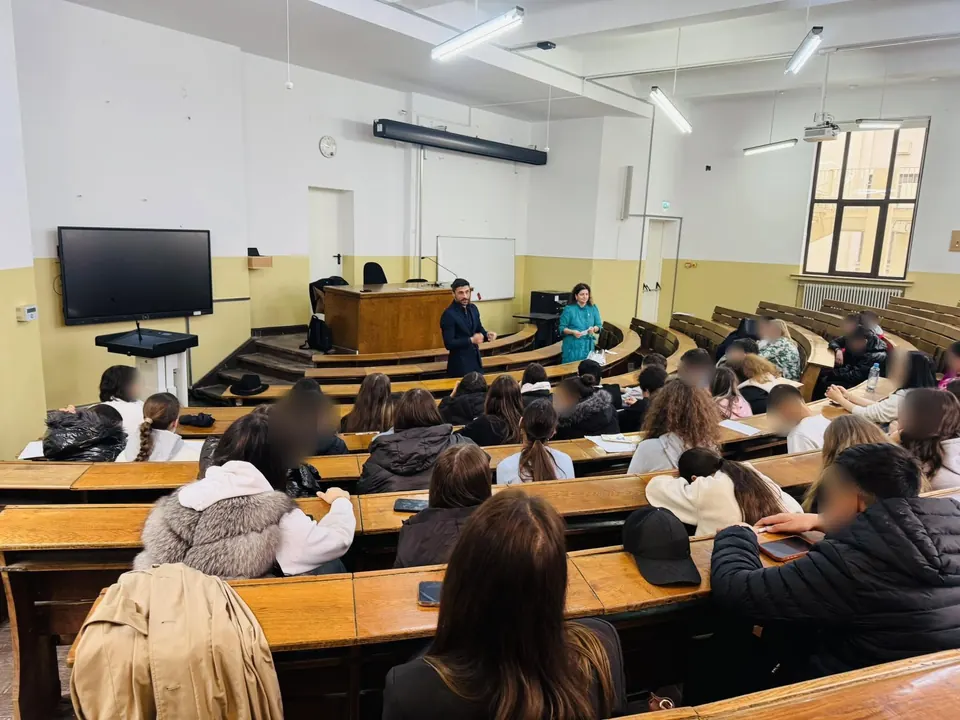
On 2 April 2026, the Faculty of Law of the University of Bucharest once again opened its doors to pupils from the commune of Cernica. This time, the eighth-graders of Secondary School No. 1 Cernica and Secondary School No. 2 Tânganu came along, accompanied by their teachers.
The meeting took place at the initiative of lawyer Laurențiu Tudorache, who represents Baro Drom and the Phoenix-Renaștem Vise Association. The pupils were welcomed by Andra-Roxana Trandafir and George Cristian Ioan from the Faculty of Law, who turned a seemingly complicated subject into a conversation everyone could follow.
The meeting is part of our series of legal education activities with pupils from Cernica, through which we want to show children that the law concerns them directly and that university is a place open to them too.
What was discussed
For almost two hours, the conversation revolved around three questions that matter to every teenager:
- Which offences are most often committed by minors? The pupils learned which acts most often come to the attention of the law when committed by children and teenagers, and what consequences they can have.
- What happens to a minor who breaks the law? The speakers explained the educational measures that can be taken in such situations and their purpose: to correct and reintegrate, not only to punish.
- How can you become a victim, and how do you protect yourself? Perhaps the most important part: how easily children themselves can become victims of such acts, and what they can do to stay safe.
The pupils’ questions
The pupils did not just sit and listen. They asked lots of questions, which their hosts described as interesting and thoughtful. Most of them wanted to know where the line is from which criminal law steps in: when an act against a person, someone’s property, animals or public safety stops being simple misbehaviour and becomes an offence.
“It was a real pleasure to meet them!”
That is how the two representatives of the Faculty of Law summed up the meeting. For us, the pupils’ curiosity is the best proof that legal education belongs in children’s lives.
Why it matters at 14
Eighth grade was not chosen by chance. In short, under the Romanian Criminal Code:
- a minor under 14 bears no criminal liability;
- a minor aged 14 to 16 is criminally liable only if it is proven that they acted with discernment;
- a minor who has turned 16 is criminally liable under the law;
- minors who are criminally liable are, as a rule, given educational measures, such as a civic training course, supervision, weekend confinement or daily assistance, and in serious cases placement in an educational or detention centre.
In other words, many eighth-graders are exactly at the age when their actions start to count before the law. Learning this from specialists, in a lecture theatre of the Faculty of Law rather than through an unpleasant experience, can make a real difference.
The information above is a general summary and does not replace legal advice. For a specific situation, please consult a lawyer.
Thank you
We thank Andra-Roxana Trandafir and George Cristian Ioan for the time, patience and warmth with which they welcomed the pupils. We also thank the Faculty of Law of the University of Bucharest, the teachers from the schools in Cernica and Tânganu who accompanied the children and, of course, the pupils themselves for their brave questions.
In the published photograph, the pupils’ faces have been blurred to protect their privacy.